Life is Still Good!!!

Tuesday, April 19, 2011

African Safari--Day 2

Our wake-up knock on the door was at 5:30 a.m., and by 6 p.m., we were all settled in the land cruiser singing "Happy Birthday" to Leonard, our guide, who turned 47. Our hopes were high that we spot some lions and leopards today. Our early morning sightings were of hippos, who live to an average age of 42, and elephants, who live to 65. Leonard explained that elephants do not die of old age but rather of starvation. Elephants are born with six sets of molars, with each set lasting about 10 years. When the last set goes, they cannot chew anymore. We followed a middle-aged elephant, probably between 30 and 40, up close and personal by driving through the bush and watching him grab the branches by his trunk and enjoying his fill of leaves. The bulls keep growing until they reach 6 tons.

Then we spotted a warthog with a face that only a mother could love. In fact, the baby warthog looked just like his mother. A herd of buffaloes were resting nearby. One of the land cruiser's drivers put out a call to the other drivers that he had spotted a lion. So all the land cruisers in our section of the park had a reunion at that spot but no one saw a lion. We just waved merrily to our fellow passengers who were on the safari sponsored by the Pacific Princess.

After a two-course breakfast back at the lodge that we thought was complete with the fruit plate before Golden took our orders for eggs, bacon, sausage and numerous other breakfast foods, Leonard offered to take us to the main lodge. Marianne, Sylvia and Sara accepted the extra ride through the beautiful countryside to Shishangeni, a half-hour drive away. When they were almost there, we passed a land cruiser carrying our deputy cruise director Frankie and other ship passengers on their way to visit our lodge. The extra amenities of the rooms at the main lodge included a mini-refrigerator, a telephone and a separate bathroom for the bathtub, sink and toilet plus a workout room and a curio shop. However, we agreed that our lodging had considerably more charm, plus the watering hole behind the Shawu and the faithful blow horns in case of an emergency.

On the trip back to our lodge, we saw a group of young impalas that Leonard said had been born in November. Was this a nursery school for them? In addition to looking at us like they knew we must be substitutes and not their regular teachers, they exhibited a sense of calmness that communicated that they had never seen a lion in this part of the reserve since they were born so we should not expect to see one either. When the three adventurers arrived back at Shawu, the land cruiser with Frankie and the gang was getting ready to leave. Ken said that he had shown Frankie our accommodations but the rest of the passengers preferred to sit on the deck behind the main building and admire the animals drinking and bathing in the watering hole. Several crocodiles joined the party in their honor.

After a delicious lunch, Bev had a massage while the rest of us spent the afternoon on the deck behind the main building or our private decks either relaxing in the sun or watching our own menagerie of African animals. When it was time to leave for our 4 p.m. game run, we debated whether we should just stay on the decks and watch the animals from there. But we were determined to spot a lion. While we had hoped for third time's the charm, we had to settle for three strikes and you're out. No lions but a lovely close-up of an elephant and another sundowner with wine and snacks in the wild.

Back at the camp, we enjoyed a fantastic going-away dinner and turned in early for our 4:15 a.m. wake-up knock on our door to leave for the airport at 5 a.m. When we finished our trip in India, we all agreed that it was incredible but none of us decided to put India on our list of countries to which we must return. As we were completing our safari, our first thought was "How soon can we do this again?" This experience was totally awesome and should be repeated as often as possible!

Durban: Africa's Answer to South Beach

Yes, getting up at 4:15 a.m. is for the birds, only if the birds really want to wake that early. On our way out of the camp at 5 a.m., we had the opportunity to say good-bye to all the types of animals we had seen but not say hello to any lions. We arrived at the gate to the Crocodile Bridge just before it opened at 6 a.m. and met our driver on the other side. Surprise! Surprise! It was Soly who had told us he was going on vacation after he dropped us off two days ago. He explained that his company had called him to let him know that it had no other driver available. The ride to the Kruger International Airport was a little more than two hours.

The Kruger International Airport was small but very nice. After clearing security, we went to our gate where the attendant made announcements to us directly. We also learned that we would be flying in a prop-jet, the smallest airplane used at that airport, so everyone would have either a window or an aisle seat or both. While we were waiting, Brent started a conversation with a man who worked for a sugar cane company headquartered in Durban. He told us about the effects of the aftermath of apartheid, which were not all good. According to him, some people had been put into positions of power that were not qualified. In addition, the new president was being investigated. Any similarities between South Africa of today and the United States after the Civil War and now are purely coincidental. The man seemed to be doing very well in South Africa as were his grown children.

On the airplane, we spoke with a couple who were originally from Johannesburg, were flying to Durban and then driving six hours south to meet friends to take a bicycle trip to East London over the next week. The modern airport at Durban had been opened on May 1, 2010, for the World Cup. Our guide Jeff told us that Durban is famous for sugar cane, which is grown year-round with sugar being its biggest export. Much of the greeness of the area was due to the sugar cane crops. Zulus harvest the sugar cane by hand because of the hilly terrain. Hand harvesting also benefits employment in a country with 35 percent unemployment. The sugar is burnt before it is harvested for three reasons: (1) the sugar cane's hard crust is crystallized by the heat; (2) the flames and smoke ward off the snakes, including the black mamba, which is extremely poisonous; and (3) burning makes the sugar cane easier to cut.

Durban is the second largest city in South Africa with the first being Johannesburg and the third being Cape Town. With the average temperature being 25 degrees C in the summer and 16 degrees C in the winter, the area never experiences any frost or ice. The warm currents of the Indian Ocean account for swimming being a year-round activity. The summers are very humid, making many days seem like standing in front of an oven. However, the year-round tourist industry makes the city vulnerable to the economic tides of the world. The city reminded us of Miami, especially with its North Beach where the trees were cut down for the World Cup creating complaints about the lack of shade, and the Zulu women who set up shop near the beach and slept there only leaving when they needed to go home for more products; and its South Beach where Zulus pull people in rickshaws.

Twenty percent of the population is white, 20 percent is Zulu and 55 percent is Indians, whose ancestors came there to work in the sugar fields in the 1800s and then started businesses. Durban has another connection to India because this was where Mahatma Gandhi was thrown off a train because only whites could ride in the first car.

Jeff pointed out the casinos, which have been allowed in the country only since the end of apartheid in 1994. The downside of the casinos was that poor people spend their last bit of money in them hoping for a big win.

The day we visited was gray, dull and rainy, which seemed what our tour of the city would be. The first two attractions we saw were the Vasco De Gama Clock erected in 1897 on which each of the four clocks had stopped at a different time and a statue of Sampson graced the center; and the statue of Dick King, who collected British reinforcements during the siege of the Boers in 1842, which resulted in a victory for the British. We then drove along part of the 15-mile harbor, the ninth largest in the world, and watched people clamming during the low tide. Jeff told us that the cruise ship in the harbor was unable to depart yesterday because of the bad weather so the passengers had slept on the ship. He also had heard that the Pacific Princess did not stop at Richard's Bay the day before because of rough seas. We pretended to admire the Sugar Terminal, which hold 50,000 tons of sugar and was built in the round because sugar gives off so much gas that a square building would crack.

He then took us to the Indian Market, where the women on our trip rejoiced in shopping while the men complained. It was difficult to get in the market because Friday was a praying day on which Islamic people prayed from noon to 2 p.m. and the Jumma Mosque, the largest mosque in the Southern Hemisphere, was near the market. Jeff told us that while we were very safe in the market, the area around it was not safe. The Indian business owners all pitched in to tackle would-be robbers. While we were in the market, the rain poured down outside.

Our next stop was the Durban Botanical Gardens, where we all wished we could have spent more time. Highlights of these gardens, which were established in 1849, were the Ernest Thorp Orchid House, the Sunken Gardens, the Garden of the Senses and the Oriental Garden. Then Jeff drove us to an overlook where we could see the entire city, which was very impressive. We also viewed the Soccer Arch for the World Games, similar to the Arch in St. Louis, which people could walk or ride up and down; and the race track with a golf course in the center. Fortunately, horse races and golf matches were not scheduled at the same time. Suddenly, Durban was suddenly looking like a very attractive city to us. The stop at a bottle store with very reasonably priced South African wine was a perfect finish for an African Safari!

Wednesday, April 13, 2011

Over-the-Top and At-the-Top Dubai

Yes, Dubai has experienced the worldwide recession but the residents would prefer no one mentions it. Construction has not picked up, and prices for residences are falling but they still have a long way to go before most of us could afford them. The Pacific Princess opened a new tour called Atmosphere Burj Khalifa, which offered the world's finest luxury dining and lounge experience with unparalleled views of the Arabian Gulf. This included a set menu with one glass of house wine and one bottle of mineral water for the cool price of $392 US each. For that price, each person should have received a case of the restaurant's finest wine and a bottle of Dom Perignon champagne!

Because we had such a wonderful private tour of Dubai last year, we decide to take the hop-on, hop-off bus at the overpriced rate of $60 per person. However, the bus does offer a recorded commentary in eight languages: English, Arabic, German, Russian, Hindi, French, Farci and Italian. The Red Route of the Big Bus Tours is the city tour while the Blue Route is the beach tour. Because the Red Route takes 1 hour and 40 minutes and the Blue Route takes 2 hours and 40 minutes, we only had time to get off the bus at two stops for 40 minutes each. At the Dubai Mall, we saw the indoor Aquarium and the Olympic Ice Rink. In the afternoon, we toured the house of Sheikh Saeed Al Maktoum, the grandfather of the current sheikh, with its large rooms surrounding a beautiful, outdoor courtyard.

The sky seemed to be hazy or smoggy but the real problem was the sand. Some of the passengers and crew were caught in a sand storm while those who went to the top of the Burj Kahlifa, the world's tallest building named after the sheikh from Dubai's big brother country of Abu Dhabi that bailed its little sister out of debt, could not see the ground because of the sand. Sara's favorite memory of the bus was the triple boys in matching short-sleeved, plaid shirts and tan slacks who entered the bus with their mother dressed in the traditional Arab clothing and father in modern garb, which seemed to be the norm in Dubai for women and men. One of the triplets sat across from Sara and very skillfully and patiently unraveled the cord of the headset. When he got to the part he could not unravel, Sara asked him if she could help. He nodded and handed it to her to complete. When she was finished, the young boy plugged it in and listened intently to the commentary. He could not have been more than 5.

Some interesting new facts that we learned about Dubai included the following:

1. Islam is the second largest religion in the world next to Christianity

2. The Dubai Creek divides the city into Deira Dubai and Bur Dubai.

3. The Metro, the fastest in the world, was opened at 9:09 a.m. on September 9, 2009 (09/09/09) by the reigning Sheikh.

4. The Dubai Flag Pole, the tallest in the world, cost $1.2 million US. The colors of the flag are red for security, green for prosperity, white for peace and black for oil.

5. The Burj Al Arab, the world's only 7-star hotel, was the tallest hotel in the world when it was built.

6. The Jumeirah Palm, islands shaped like a palm tree, is considered the Eighth Wonder of the World. Workers dredged sand and rock from the bottom of the Arabian Gulf to create the trunk and 17 fronds or branches, which play host to 20,000 visitors a day. The streets are named (Alphabet Letter) Frond--great address.)

7. A poem written by the current sheikh ends, "Not everyone who rides a horse is a jockey. Great men rise to greater heights."

8. When they were built, the twin Emirates Towers were the tallest buildings in the world. Now that title is held by Burj Khalifa, which has been constructed so more floors can be added to keep its title.

9. Citizens and expatriots can purchase an island in The World islands for $10 million US to $100 million US.

10. Sara wants Ken to go back to work so we can purchase one of those islands in the next 100 years or so. Yeah, right!

Sensational Seychelles

Probably everyone has had a day, which they thought they had planned, that turned out completely different from the itinerary but better. That was our day in the Seychelles. Because of problems with piracy, we had been told that we would not be stopping there but then the ship put it back on the schedule. Those in the know say that the best beaches in the world are located on Bora Bora, Moorea, and the Seychelles. Having never been to Bora Bora, we cannot comment on their beaches. But if the winner of the "best beach in the world" came down to Moorea or the Seychelles, we could not decide--both are marvelous and spectacular.

We had just finished five sea days in a row. Our destination port lecturer Richard had informed us that Mahe had little to see in the name of history so we should just "beach" it. That's exactly what we planned to do. However, we were having a Cruise Critic Luncheon the first sea day after the Seychelles so we have been receiving telephone calls from other members to RSVP. When Audrey called that morning to make reservations for her and Mel, she asked Sara what we planned to do. When Sara answered, "Go to the beach," Audrey suggested that we share a cab. Sounded like a plan to us.

When we left the ship at 8:15 a.m., the temperature had to be in close to 90 degrees F. We walked into Victoria, the capital of Mahe, the largest and most important island in the Seychelles, and took a photograph of the Clock Tower. The island's most famous landmark is a replica of a clock erected in London in 1897. While it does not chime, it strikes the hours. Mahe was considered the place that unwanted characters throughout the world could be disposed of between 1798 and 1963, making it the home of many infamous undesirables.

We then toured the Museum of History for less than $3 US per couple. One of the most painful exhibits to read and view was the history of slavery on the islands or how humankind can be so cruel to itself. The life of the rich landowners was one of leisure with parties, dancing, singing, games and relaxation. The life of ordinary families consisted to working for someone else to be called to work at the landowners whim because the residents obeyed the cardinal rule of their existence--do not disturb the landowner or risk being sacked or evicted. The life of the slaves evolved around work from early morning to late evening when they returned to their small huts or make-shift shelters under the houses of their masters, where they were chained up so they could not escape. Two famous slaves were Castor, who was freed on the condition that he would turn in runaway slaves to the law officials, and Pompeii, who was probably falsely convicted of killing a white man and sentenced to death. Because there was no means to execute him on the island, he was burnt at the sea border at 3:30 p.m. We also saw a model of Venn Town, a mission established by the Church Missionary Society of London in 1875-76 to care for and educate children of slaves freed by the British Navy.

Punxsutawney Phil was in Groundhog Heaven when he spotted a model of a payot, a possibility for an indoor burrow where he could make his weather prediction on February 2, 2012. The description of his potential future home is "wood frame covered with a corrugated iron sheet roof with toilet and kitchen facilities outside." For Phil, his next place of residence is a toss-up between the payot and the tree trunk on Moorea.

After visiting a South African store to marvel at the African Gemstone Collection, jewelry, paintings, artwork and souvenirs, we stopped at Vision Voyages travel agency, which we picked because it was the first travel agency we came to on that side of the street. Audrey, who is a travel agent, said we would give the agency 10 minutes to let us know if someone could do a private tour for us before we had to board the Pacific Princess at 3:30 p.m. In addition to the sheer beauty of the island, another thing everyone we have talked with agreed on was how friendly and helpful the residents were. After trading business cards and discussing possible business from travelers whom Audrey knows, Lisette Marie, the sales and reservations executive, called her brother-in-law Daniel to drive us around the island. Lisette, who is 41, married, mother of 18- and 11-year-old sons, looks young enough to be dating an 18-year-old and has a brother and sister with whom her family gets together at Mom's house for dinner on Sundays, invited us to join them for dinner the next time we were in the Seychelles. In addition, she led Mel and Sara through the back streets of Victoria to a local beverage store to buy wine that was not "way too expensive." Sara purchased three bottled of Feldefer, a French wine that she chose because she was so intrigued by its stopless cap.

After Ken and Audrey declared that Mel and Sara were gone on their wine-shopping mission way too long (fewer than 15 minutes), we all started off across the island to the beaches on the west coast. The van climbed steadily up a winding road through dense, lush, green vegetation that was growing hard to block out the sun and reminded us of our wonderful day in Picton, New Zealand, last year. Daniel told us that both tourism and the cost-of-living has risen in the last two years. A modest two- or three-bedroom house with a view of the sea sells from $2 to $3 million rupees (divide by 12 for US dollars). We stopped to photograph the giant tortoises, the heaviest land tortoises in the world, and the symbol of the islands. We also visited Morne Seychellois National Park, on the original site of Venn's Town, with its breathtaking vistas that we wanted to burn into our mind to remember when we needed an imaginary vacation for a few minutes to relieve stress.

After we got back into the van, Daniel drove us to one of those glorious beaches where we waded in the warm, wave-lapped water up to our knees so we did not have to sit in the van in wet bathing suits. Then we decided to get a quick lunch at a resort on the beach. As the saying goes, the best laid plans of mice and men often go astray. Audrey and Mel decide to split a pizza and drink beer. Sara wanted to split a pizza with Ken but he decided if he was spending money for lunch, he wanted a ham and cheese sandwich, so Sara ordered a pizza by herself. The pizzas arrived shortly after the beers so Audrey, Mel and Sara greedily dug in. Ken waited patiently, well not so patiently, for his sandwich. The rest of us suggested that Ken cancel his sandwich and eat the rest of the pizza. Ken tried to cancel the sandwich twice but the waitress said the chef was already cooking it. After 45 minutes and everyone else long finished with lunch, Ken told the waitress we were leaving and she appeared with the sandwich and French fries in a box. As Ginger, our table mate would say, it was cute food--layers of sliced ham and cheese, no cooking involved, and quite small. Mel insisted that we not leave a tip, and then said, "I told you we could have gone to the other restaurant but no one would listen to me," in a semi-joking tone. Ken not getting his meal on time also is reminiscent of Picton.

Once we actually escaped from the restaurant with the cute sandwich that Ken shared with Daniel, we drove across the island again to get back to our ship by 3:15 p.m. Daniel pointed out a huge mansion on the hill that was owned by the King of Saudi Arabia and told us the door handle on the front door was pure gold and the King planned to install a cable car to travel up and down the hill. To thank the people of Mahe for being such gracious neighbors, the King has sponsored a $35 million hospital, five coast-guard boats, a turbine to generate electricity and radar on the island to maintain privacy and prevent piracy. We stopped at another overlook with an incredible view that faced Eden Island billed as "a private residential marina development with luxurious apartments, maisons and spacious villas."

We arrived back at the ship 15 minutes before the all aboard so we shopped at the vendor stalls that had been placed in our honor. At 3:25 p.m., a crew member motioned us on board. The last passengers to arrive were Joe and Ginger at 3:35 p.m. after their adventures at the beach with riptides and a visit to the studio of artist Michael Adams, who told them that the complexion of the Seychelles was changing because of the Arab and Russian millionaires who are buying up the homes and property. How can this be? We just discovered the Seychelles, and they are a-changing.

Punsxutawney Phil spent the rest of the afternoon and all night looking out the window in our cabin trying to determine how to get back to the Seychelles. If he could have figured out a way, Sara, our cruise director Brett and a number of other passengers and crew may have gone with him.

East London: An Extraordinary Adventure

The scuttlebutt on the ship was that the reason the Pacific Princess docked at East London was that it needed a port between Durban and Cape Town where the passengers who had gotten off the ship for the overnight safari to Prinda Game Preserve could reboard the ship. The ship tours were extremely expensive because "due to a lack of local services, buses and guides are brought in from areas the day prior to the ship's arrival. The cost of tour reflects the costs of these additional services." The morning of the tours, we learned that the East London Museum, with its native Xhosa cultural exhibits and the world's only dodo egg, was closed due to a workers' wage strike because they did not like the results of the recent election.

Because we had just returned from our safari the day before and the ship offered a complimentary shuttle to the Hemmingway's Shopping Center, we decided to take it. We wrongly assumed that the shopping center would be in the center of the city because that was where anything of any interest was. After leaving the port, we were soon on an expressway to an upscale mall where the prices were expensive. Sara gave the mall experience about 45 minutes before we decided to find a cab to take us to Queen's Park that offered a small zoo and botanical gardens. When we went to the basement of the mall to use the restrooms, Ken started a conversation with a couple who had brought their young son to the mall to target shoot. When we asked what would be best to do in East London, the woman told us that the beaches on the other side of the river where they lived were beautiful. She also warned us not to take a cab because the cabs were "dark." It took us several beats to realize what she was trying to tell us was the cab drivers were black, and they spendtmore money on the cab's stereo equipment than they did on the cab. The couple offered to drive us to Queen's Park but they were not sure how we would get back to the dock. Because the route seemed to be out of their way, we graciously declined their offer.

Not sure what to do, we saw Audrey waiting for Mel to come out of the restroom. When we told her we planned to take a cab to the park, she suggested that we all go together because we had enjoyed our experience in the Seychelles so much. Mel said he would like to use the computer in the Internet Cafe to confirm their plans for when they would leave the ship in Cape Town. So the three of us went up to a cafe on the ground level where we ordered a bucket of six Castle beers and French fries. When Mel joined us and we finished our refreshments, he asked for 20 minutes to look for a shirt. When he had not returned in a half-hour, Audrey said that he would have to pay for that. Five minutes later Mel approached us asking for Audrey's opinion on a shirt he liked but that needed alternations. So we all followed Mel to Truworth's Department Store, similar to Macy's in the U.S., and agreed he should buy the shirt. Then we asked a clerk at the information center where we could get a taxi.

When we exited the mall where the clerk directed us, we were in a parking garage. Mel approached a man, who was getting ready to load groceries in his car, who basically told us that we could not get to the cabs from where we were and asked us where we wanted to go. He told us that he could take us to Queen's Park because it was on his way home so we accepted his offer. Etieene van Rensburg, manager of the ASAP Properties with four employees, has a father who lives with his second wife and three children 10 miles from where Audrey and Mel live in Vancouver--small world. He earned a master's degree in religion in Durban, but now calls himself an agnostic because he learned too much, before he returned to East London where his mother lived. As we entered the expressway, he suggested that we not go to the park but rather let him give a tour of what makes East London East London. Sounded good to us.

First we drove through some neighborhoods where the wealthy people live. Then we toured middle-class and lower-class neighborhoods. After that we saw a black neighborhood and Etieene explained to us the difference between black and colored, with the colored people being of mixed origin when the Dutch came to South Africa in 1662 and intermingled with the native tribe. Then he drove us through the neighborhood that we know no one else from the ship visited, Duncan Village, a squatters' settlement of people from the less developed areas who lived in make-shift shacks with tin roofs. Two or three families live in each shack, which is one of the reasons for the high rate of HIV. When Ken asked about where the squatters went to the toilet, Etieene explained that there was a communal bathroom for about every 10 shacks. Unfortunately, the last president of South Africa did not think that the treatment of HIV-AIDs was necessary. Some claim his lack of action was a form of genocide.

Under the Apartheid government, whites and blacks were separated for education, and this system has not yet been corrected. The blacks with money have moved into the white school districts so their children receive a good education. Etieene related that the black teachers in the black schools send their children to the white schools. While a lot of money is being spent on education, it's not going to the schools but into someone's pocket. The educators have the biggest union in the country but the literacy rate is low. While many changes are taking place in South Africa, a few at the top are the ones who are receiving the benefits.

Etieene then drove us into the center city where we thought all the tourist attractions would be. At the markets, lots of life was going on but the four of us would have stuck our like the proverbial sore thumb. Our impromptu tour guide told us no one should walk around there with cellphones, jewelry or cameras. Later, we learned that a passenger from the ship was waiting downtown while his wife was looking at jewelry when he sensed something behind him. When he put his hand in his pocket to check for his wallet, he felt another hand there--not a good feeling. Fortunately, the would-be mugger ran away. There was a reason why the Pacific Princess wanted its passengers at the safe, upscale, lily-white, suburban mall. Etieene had an interesting theory on way the crime rate was high, especially in Johannesburg, South Africa's wealthiest city that we are now not sure that we would want to visit. He thinks that once people have tasted wealth, they want it and are willing to steal and kill for it. People who have never experienced what money can buy do not know what they might be missing.

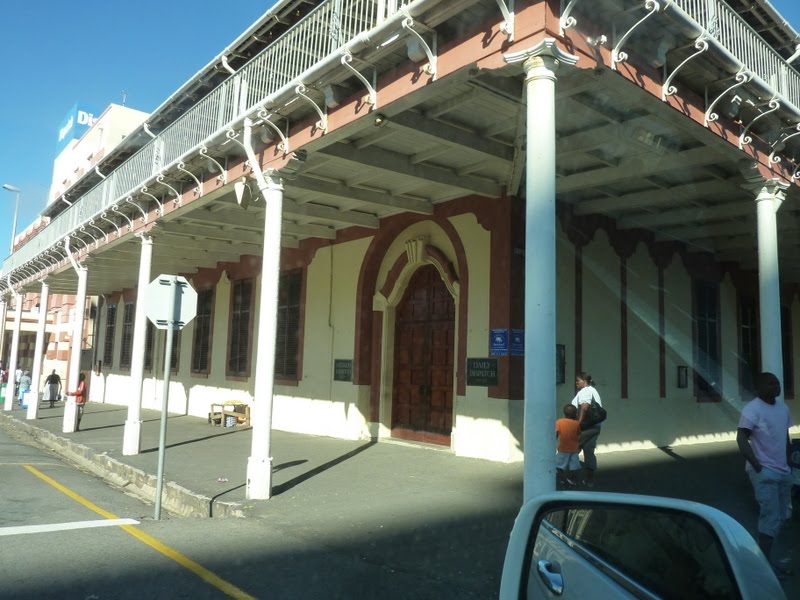
When we asked Etieene about the city's cultural activities, he explained that until recently the city lacked academic institutions but now several black universities, including the University of Fort Hare, were creating campuses there, which should lead to more theater and art. Our tour of the main street in downtown East London, Oxford Road, included City Hall, which is very British in design; the building that houses the local newspaper, the Dispatch, which looks like it could be in New Orleans; and a former Pontiac dealership that had maintained its Indian head sign. The stores on Oxford Road had closed at 1 p.m. because it was Saturday. Off the main street was the bright yellow ASAP building of Etieene's company.

East London is heavily dependent on Mercedes Benz that built it first plant outside of Germany there. This plant has earned the highest level of quality from the company. Etieene pointed out that the ship next to the Pacific Princess in the port was a ship loaded with Mercedes Benz for export. Unfortunately, the city's residents do not receive a discount should they buy a vehicle,

After two hours of acting as our personal tour guide, Etieene returned us to the port so we could walk to the ship. When we tried to pay him, he refused. We gave him our business cards and invited him to visit us. Audrey promised to contact his father when they returned to Vancouver. Etieene, who has never visited his father in British Columbia, told us that he would really like to travel to Cuba to see the world's smallest bird, the bee hummingbird, before he dies or it dies. We told him that we hoped to be able to visit Cuba someday because its only 90 miles from Key West.

Once on the ship, Ken decided to spend time at the pool while Sara started working on the blog. At about 4 p.m., she heard music coming from outside. In front of the ship was a band with horns and drums that entertained the passengers. Once again, a day that we thought would be ordinary turned into extraordinary. Mel believes that he has angels watching over him because things like this happen to him frequently. Maybe we are pretty lucky, too. We are really going to miss Audrey and Mel when disembark in Cape Town.